With AI workloads becoming more widespread and powerful, data centers are under pressure to keep up and they’re literally becoming hotter. High-density racks supporting GPUs and large AI models are pushing thermal loads well beyond what legacy designs can handle. Without new approaches, operators risk jeopardizing uptime, flexibility, and project timelines. Meeting these demands requires cooling strategies that adapt to the dynamic requirements of AI.
AI Is Raising the Heat, Hybrid Cooling Is the Answer
Today’s data centers are facing a seismic shift in rack power density. While legacy facilities previously operated at lower loads, next-gen builds are targeting much higher densities to keep pace with AI and accelerated computing workloads.
These thermal loads create urgent challenges for both power and cooling infrastructure. Liquid cooling is gaining ground, especially direct-to-chip solutions, but meeting AI’s demands will require a combination of approaches.
With uncertainty around how AI will scale and what future workloads might require, many operators are opting for hybrid cooling systems that support both air and liquid. No operator wants to over-engineer and risk developing soon-to-be outdated infrastructure, but underbuilding can be equally as costly, from retrofits to missed revenue opportunities.
Designing for flexibility is essential to accommodating future workloads, which is why there’s an emphasis on prioritizing versatile infrastructure that can adapt to demands that shift in scale, intensity, and timing. From containment systems to overhead support structures, flexibility in design is a key spec.
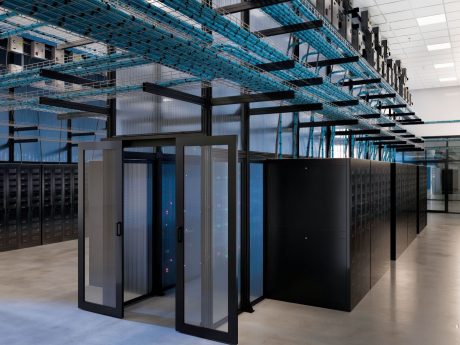
Containment systems now need to support more than just airflow. They're becoming structural elements, holding up cable trays, busbars, and even water lines for direct-to-chip cooling. Supporting structures, often floor-mounted, are now under pressure to carry much heavier loads, including dynamic forces introduced by circulating liquid.
To meet that demand, some manufacturers are reinforcing their support systems with stronger frames and more adaptable components. There’s also a notable shift toward hybrid frames combining lightweight aluminum with highly adjustable systems.
Deployment-Ready Cooling That Delivers on Efficiency
Cooling remains one of the most significant contributors to a data center’s total energy use. Inefficient systems can increase operating costs and complicate efforts to manage PUE and meet carbon reduction goals. As AI drives higher rack densities, energy-efficient cooling becomes essential for both thermal performance and meeting environmental targets.
Modern systems are integrating sensors and smart controls to adjust airflow and cooling output based on real-time demand, reducing overcooling and wasted energy. These adaptive systems help improve efficiency while supporting operational reliability.
As operators race to bring AI-capable capacity online, speed and ease of deployment are vital. Cooling systems that are fast to install, easy to scale, and compatible with phased deployments are in high demand. In retrofit scenarios, this often means minimizing invasive construction and instead opting for modular containment and cooling units that can be deployed with minimal disruption to live environments.
Vendors that control their supply chains, reserve production capacity at mills, and offer preconfigured or preassembled options are gaining an edge. They can respond to RFIs, design changes, and accelerated timelines without compromising project schedules or performance.
What to Watch: Smarter Infrastructure, Stronger Performance
As AI workloads evolve, so too must the infrastructure that supports them. Operators are increasingly prioritizing flexible systems that can scale with demand, from containment strategies designed for higher thermal loads to structural ceilings engineered to support heavier overhead utilities. Ceiling panels that enhance airflow containment without costly retrofits are also gaining traction.
For now, designing around adaptability remains the best safeguard against an uncertain future. Hybrid cooling systems that balance performance, scalability, and installation flexibility are emerging as the go-to standard for AI-ready infrastructure.
At Armstrong, we see growing demand for solutions that do more than just manage heat. They optimize uptime, reduce energy waste, and keep infrastructure resilient as workloads shift. From modular containment systems like COOL SHIELD, to DYNAMAX structural grids and AIRASSURE ceiling panels, infrastructure that supports cooling and performance is fast becoming the standard for AI-ready environments.
Find out how our versatile containment solutions can help future-proof your data center strategies.