
The Vision
As the new center stage for Phillips Academy’s orchestras, concert bands, and chorus, the performance hall needed to give performers and audiences an ideal acoustical and aesthetic experience worthy of its namesake, John Barry—a legendary composer and conductor influencing music in film, television, and stage on two continents.
The Challenge
The John Barry Performance Hall required a state-of-the-art acoustical ceiling for a 238-seat dual-purpose space that would be used for both rehearsals and performances. Acoustics in the space needed to provide optimal experiences for performers and their audiences, as well as perform strongly at times when a portion of the seats were retracted. As a critical component of strong acoustical performance, the ceiling and wall design needed to achieve ideal levels of sound absorption and reflection, which varied for the musician and audience sections of the hall. In addition, the ceiling needed to bring to life the design team’s vision for a bold ceiling that gave the hall a sense of movement, openness, and musicality. When it came to installation, the design wasn’t the only element that was “elevated” to align with the purpose and atmosphere of Falls Music Center. The ceiling itself would need to be installed at a significant height of 40 feet in a space that allowed for only a few workers at a time. Lastly all acoustic and aesthetic demands placed on the hall’s ceiling and walls needed to be achieved within a preparatory school budget.
“On a complexity scale of one to 10, the John Barry Performance Hall rated at least an eight,” said Mario Botelho, Director, Construction Services for CASTWORKS at Armstrong. “Even after we identified Armstrong CASTWORKS panels as the best solution, the customization and optimization of acoustics came with some challenges. But, at the end of the day, the story of the project’s success came from exceptional collaboration and the leveraging of Armstrong’s experience to tweak the design, meet the acoustician’s parameters, and deliver a constructable, on-budget customized GRG solution.”
The Solution
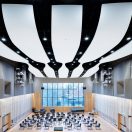
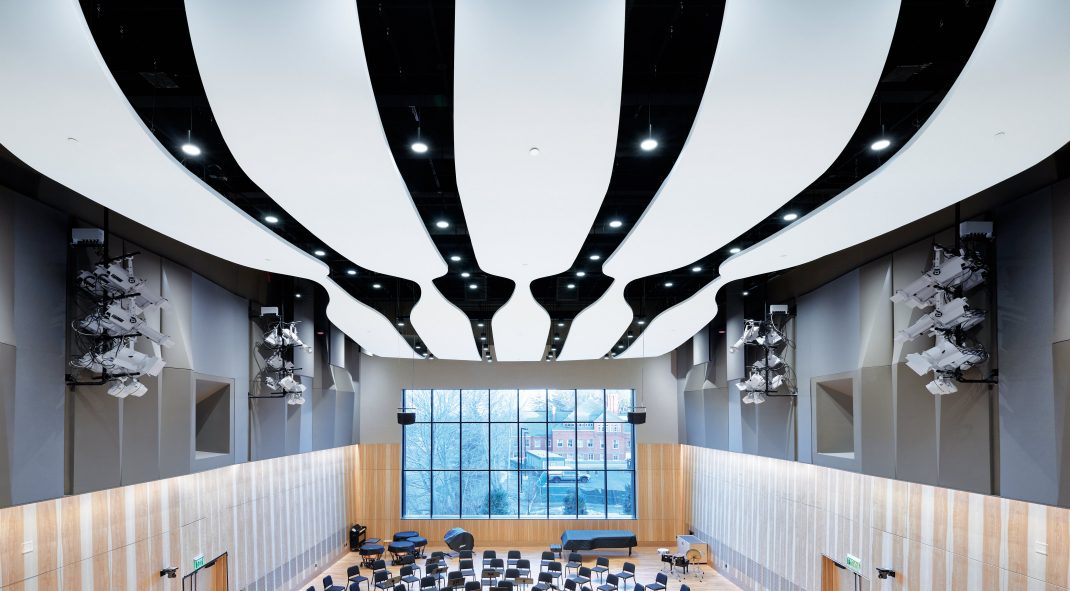
Essential to aesthetics and acoustic performance were five customized Glass Fiber Reinforced Gypsum (GRG) ribbons and faceted acoustical walls formed from custom Armstrong CASTWORKS panels. Key to achieving a constructable solution were preconstruction work, customization and collaboration between Armstrong, ARC (architect), Kirkegaard (acoustician), and T.J. McCartney, Inc. (contractor). All these resources came together to help manage costs, facilitate installation and create the design of the ribbon ceiling and custom wall panels to meet demanding acoustic requirements of the multi-purpose practice and recital space.
Armstrong customized its CASTWORKS GRG with embedded acoustical compound. This would challenge the installation team with panels that were heavier than typical GRG. In addition, the panels were manufactured at a thicker-than-normal cast—1/2” vs. 3/16”— to reflect and scatter sound throughout the space.
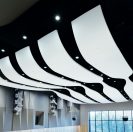
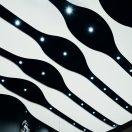
Armstrong also developed prototype molds and prioritized repetition to keep costs down. Despite complex geometry and varying curves and widths, Armstrong utilized just 16 molds, casting 190 GRG panels to create the ceiling ribbons and walls. The spacing between the ribbons was calculated to meet requirements for acoustics, allowing sound to reflect or pass through the ceiling to enhance the performance. Spaces also created the illusion of darkness, offering the desired bold visual contrast to the clean, white GRG ceiling panels.
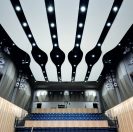
Next, the teams addressed multiple constraints for the 238-seat space. It was decided that ceiling panels would be assembled on site into five undulating ribbons. The ribbons were suspended—using the Armstrong FRAMEALL pre-engineered drywall suspension system to reduce installation time—at specific heights, slightly different angles and specified spacing. In addition to being critical to the proper placement and efficient installation of the GRG ribbons, the drywall suspension system helped ensure that hardware and wiring for lighting, sound, and other equipment was hidden from view.
Ensuring constructability of the ceiling that was a virtual “puzzle” to assemble was paramount. To ensure as smooth an installation as possible, Armstrong provided T.J. McCartney with mock-up panels, allowing installers to become familiar working with their size and weight. As a resulted of this, Armstrong made adjustments to panel customization—placing wood-blocking for connections at the installer’s recommendations. Embedded suspension hangers also supported installation.
The dimensions of the performance hall made for tight quarters, allowing only a few installers to work at one time. In addition, for safety reasons, other trade workers were cleared from the space, putting additional pressure on crew to complete the ribbon installation as quickly as possible. When it was time to start installation, Armstrong shipped crates of GRG panels as needed to conserve space. Detailed shop drawings helped ensure correct on-site assembly of pieces for each of the five ribbons. Each ribbon was hung as 10 separate pieces using lifts on either side. These were taped, mudded and finished in the air, creating a seamless look.
“Even with all the detailed curves, bevels and angles, challenges were solved in pre-construction and accurate shop drawings ensured we had everything ready,” said Jessica Blanco, Assistant Project Manager, T.J. McCartney. “We didn’t have to do anything twice on the job site. We met our timeline, budget and it looks awesome.”
From the audience viewpoint, GRG ribbons offered a flowing, monolithic visual directing the eye to both the performers and the natural environment surrounding the performance hall. Faceted walls assembled from GRG also added to the aesthetics and strong acoustic performance.
The hall’s first concerts occurred in February 2025, receiving high marks from performers and audiences.
“The manufacturer offered choices that made the ceiling and walls buildable, affordable and able to meet acoustical requirements,” said Joseph Myers, Partner, Kirkegaard. “Collaboration across the board resulted in a space that looks and sounds beautiful.”
Project: John Barry Performance Hall | Phillips Academy Falls Music Center
Location: Andover, MA
Architect: ARC (Architectural Resources Cambridge)
Products/Services: